As individual components grow larger, the fabrication method becomes a significant factor in determining whether the finished assembly performs as intended. Even minor inconsistencies, which may not compromise smaller parts, can introduce cascading problems in oversized components, including measurable distortion, bowing, and stress concentrations. Different forming processes, from welding and plate rolling to large-scale press brake fabrication, shape metal in various ways, directly influencing strength, rigidity, and long-term reliability.
Why the Fabrication Method Is a Big Deal for Oversized Projects
The bigger the part, the less forgiving the fabrication process becomes. In oversized fabrication, every inconsistency and weakness becomes magnified as components increase in size. The risks of poor fit-up and premature failure also increase, making it particularly important to identify and mitigate potential problems before they are introduced during the fabrication process. The most effective way to do so is to choose the fabrication method that prevents the introduction of weaknesses.
Plate rolling, for example, is effective for creating cylindrical shapes and sweeping curves, but it can thin the material along the bend line. These variations grow more pronounced as plate size increases, resulting in weak points that can fail under load. Angle rolling presents similar challenges, often resulting in a twist or sweep that requires significant correction. Other processes, such as panel bending, rely on smaller segmented tools that can leave slight step-offs or inconsistencies, which aren’t structurally consequential on a small panel but can compromise stiffness on a large plate.
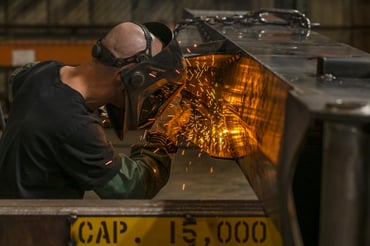
Welding, whether manual or robotic, is one of the most common methods, next to large-scale press brake fabrication. However, it adds heat-affected zones, distortion, and weak points that behave unpredictably as the part grows in size. Large-format press brake forming is often the superior choice because it reshapes the metal cleanly, predictably, and with far fewer structural compromises.
The Structural Advantages of Large-Scale Press Brake Fabrication
Large-scale press brake fabrication offers structural benefits that become especially important as components grow in size. Unlike processes that rely on heat or multi-step forming, the press brake uses controlled, evenly distributed force to shape metal without disrupting its natural properties. This approach produces cleaner bends, more predictable material behavior, and stronger results across large assemblies.
- Preserves Grain Continuity: Press brakes form metal in a single, controlled motion, keeping the material’s grain structure intact along the bend. This creates a stronger bend line and avoids the thinning and micro-fractures that can occur with rolling or aggressive forming methods.
- Ensures Uniform Strain Distribution: In large-scale press brake fabrication, the forming force is spread evenly across the entire bend length. This even distribution prevents localized stress concentrations that can turn into weak points, especially on long or heavy plates.
- Minimizes Distortion: With no excessive heat input and minimal manipulation, parts retain more accurate geometry. During the fabrication process, oversized components stay flatter, straighter, and more consistent, which reduces the amount of straightening or rework needed downstream.
- Maintains Section Strength: Press brake forming utilizes controlled displacement shaping, which preserves the original material thickness. Instead of stretching or compressing the metal unevenly, the press brake maintains the structural value engineered into the part from the beginning.
- Limits Residual Stress: Large-scale press brake fabrication avoids introducing internal stresses that often appear in heat-heavy or multi-pass forming methods. By minimizing these stresses, large components are less prone to warping during assembly or shifting under load in the field.
Together, these advantages produce assemblies that are stronger, more stable, and far more predictable at scale. This foundation of structural integrity is the primary reason large-scale press brakes consistently outperform alternative forming methods.
Where Large-Scale Press Brakes Outperform the Alternatives
Large-format press brakes excel in areas where other forming methods begin to struggle, especially when the materials become thicker and the parts exceed typical dimensions. Rolling, welding, and segmented bending all introduce variables that multiply as parts scale. A minor deviation in a small component can become a significant structural or alignment problem. Large-scale press brake fabrication avoids many of these pitfalls by applying clean, controlled force through a single, continuous motion that keeps the material stable and produces predictable results.
The most significant advantage of large-scale press fabrication is the repeatable forming process that delivers consistent accuracy across the entire length of a part. Long, heavy parts remain straight, maintain their dimensions, and retain their intended shape throughout the process. That accuracy directly reduces downstream problems and shortens overall production time because the parts emerge from the press much closer to final specifications than they would through rolling or welding processes.
As parts get larger, the process remains stable, allowing fabricators to work with heavy plate and oversized components without introducing the stress patterns, distortion, or variable wall thicknesses that often accompany alternative methods. This reliability is a major reason why press brakes are the preferred choice for structural panels, pole sections, and large fabricated assemblies that require strength, straightness, and consistency from end to end. For operations like HMMI, LLC—where scale is the norm, not the exception—this capability is central to delivering components that perform as expected in demanding field conditions.
The HMMI Advantage in Oversized Fabrication
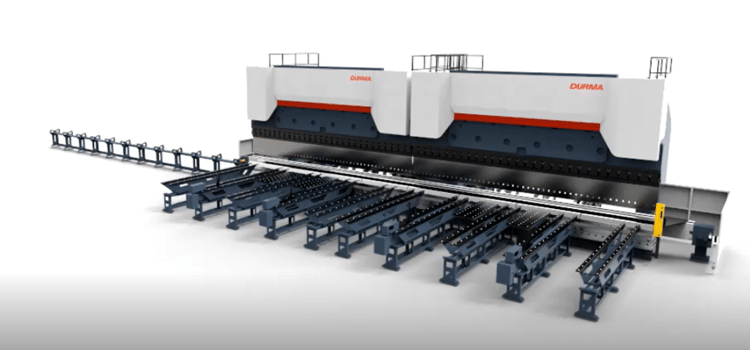
When your project demands strength, scale, and precision, the right equipment makes all the difference. Horizontal Machining & Manufacturing is built specifically to handle large and heavy fabrication projects. Our advanced large-format press brake technology is designed to handle the weight, width, and structural demands of oversized components. Paired with precision handling systems and the expertise of operators who work at this scale every day, these capabilities enable us to form massive assemblies with the same accuracy and consistency expected of much smaller components.
If you require large-scale fabrication that performs reliably under load, in harsh environments, or across extended service life cycles, HMMI,LLC is well-equipped to deliver. Contact us today to discuss your project and explore how our press brake capabilities can enhance your next build.